Custom Segment LCD: From Drawing to First Article
A segment display looks like the simplest product on the shelf. It is also the one with the longest tooling chain — almost nothing about it is standard.
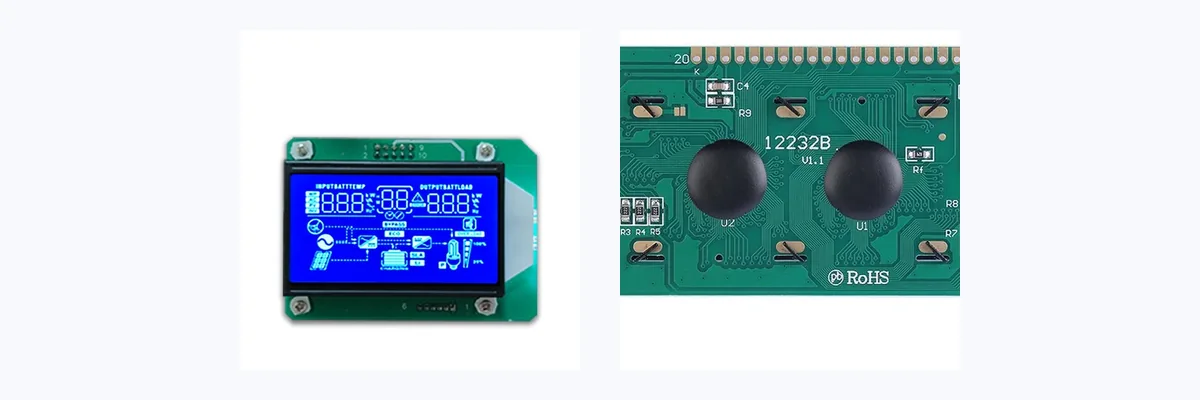
A segment LCD looks simple: a few digits, a battery icon, maybe a signal bar. It is also the display type with the longest tooling chain in our factory, because almost nothing about it is standard. The ITO pattern that draws those digits is etched from a mask made for your product alone.
What "custom" actually means. Four layers change together. The glass carries the segment pattern and the routing that brings every segment out to a pin. The polarizer decides whether the display is positive or negative, and whether it works by transmitted light, reflected light, or both. The backlight sets colour and brightness. The connection — metal pins, zebra connector, heat-seal FPC or a soldered tail — decides how the module meets your board. Change any one of them and you have a new part number, even if the digits look identical.
Start from the display content, not the electronics. Send the artwork at actual size, with every segment lit, plus a separate drawing of what is visible when the product is off. A pattern that reads well on paper becomes unreadable when the gap between two segments falls below roughly 0.2 mm at a one-metre viewing distance. The same applies to the stroke width of an icon: thin strokes break up first.
Duty and bias decide the drive, and the drive decides the glass. A static-drive display and a 1/4-duty, 1/3-bias display are not interchangeable, even when the artwork is the same. Tell us which controller you plan to use — or let us propose one — before the pattern is frozen. Changing duty after tooling means a new mask.
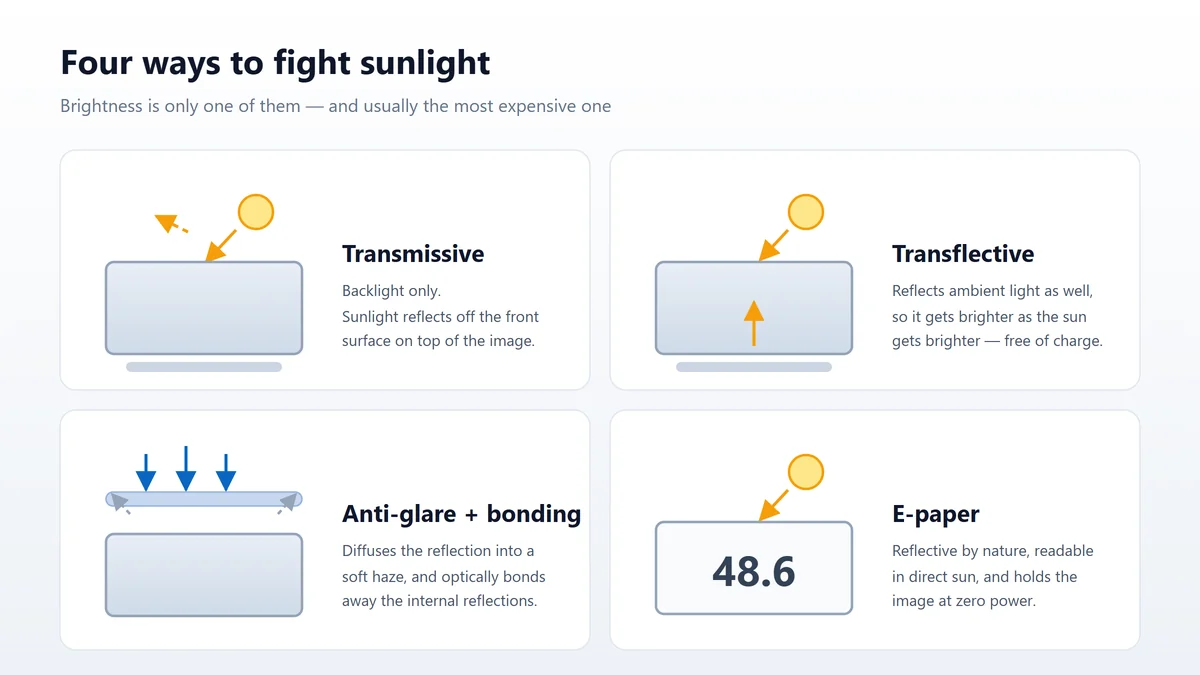
Viewing angle sets the technology. TN is the cheapest and the narrowest. HTN buys a little contrast. STN widens the viewing cone, FSTN gives the best contrast for negative images, and VA produces the deep black that makes a negative display look modern. Negative displays need a backlight; a reflective negative display is a contradiction and will disappoint you outdoors.
Environment decides the polarizer and the temperature range. Standard modules run -20 to +70 °C. Outdoor equipment, automotive aftermarket and anything that ships in a container needs -30 to +85 °C, and often a UV-stable polarizer as well. Humidity matters too: a display that fogs behind its window is usually a mechanical problem, not an LCD problem, but it is worth raising at the drawing stage.
Tooling is the schedule. The mask, the sample build and the first-article inspection are what take the time; assembly itself is fast. The first article is where you validate segment shape, contrast, backlight uniformity and connector alignment against your enclosure — not just against the drawing. Approve a golden sample in writing and keep it; that sample is the contract for every later shipment.
What to send us. Artwork at 1:1 with dimensions and tolerances, duty and bias plus the controller, viewing direction, polarizer type (positive or negative, reflective or transmissive), backlight colour and brightness, a connector drawing, the operating temperature range, and an annual volume. With those eight items we can quote in one working day and start tooling without a second round of questions.
We have been building segment displays for more than seventeen years, alongside TFT, OLED and e-paper, and we keep over a thousand standard modules on the shelf for the cases where a custom mask is not worth it. If your volume is small, ask us whether a standard part with a different backlight will do the job — often it will, and it ships in days instead of weeks.