COG vs COB: Choosing the Right LCD Module Structure
The driver IC can sit on the PCB or directly on the glass. That one choice decides how thick your module is, how narrow the border can be, and which option is cheaper at your volume.
Every character and graphic LCD module does the same job: drive the pixels. The difference between COG and COB is where the driver IC lives. That single decision changes thickness, border width, tooling cost, and how much space your enclosure has to give up.
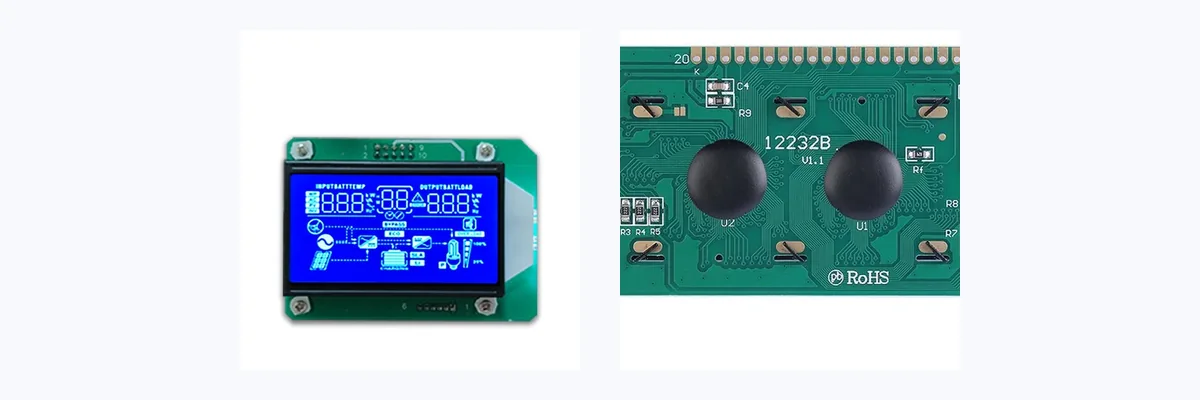
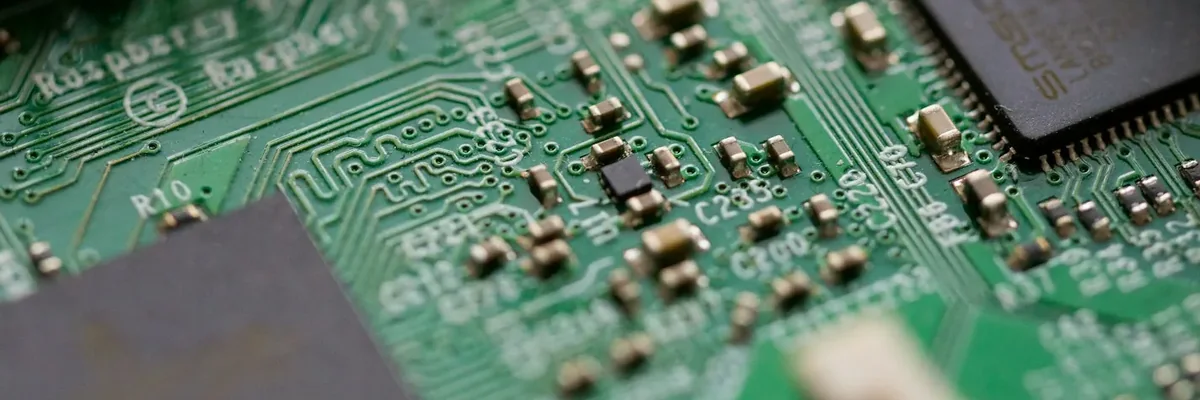
In a COB module (chip-on-board), the driver IC is die-bonded onto the PCB, wire-bonded with gold or aluminium wire, and sealed under an epoxy glob. The LCD glass sits above the board and connects through it. Because the PCB carries the routing, the glass stays simple — which is why COB tooling is usually the cheaper one to start with.
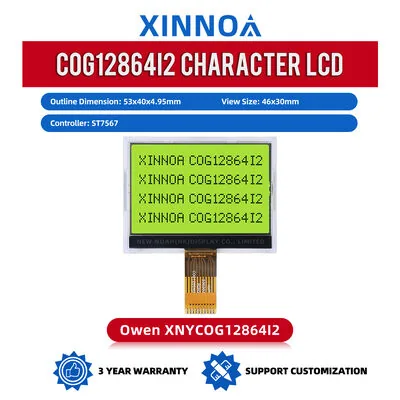
In a COG module (chip-on-glass), the IC is bonded directly onto the ITO traces of the glass, and the FPC connects to the glass instead of a board. There is no PCB under the display at all. Removing that layer is what makes COG modules thinner and allows a much narrower border.
Thickness and border go to COG. A COB module carries a PCB plus a sealed IC, so the stack is typically a millimetre or two thicker, and the border has to accommodate the board outline. If your product has a tight bezel or a flush front panel, that difference decides the design.
Cost depends on size, not on the technology itself. Small displays up to about three inches often cost less in COG: no PCB, no board-level connector, fewer assembly steps. As the glass area grows, routing on the glass becomes more expensive and COB takes over — which is why most character modules and large monochrome displays are built in COB.
Mechanical behaviour favours COB. The PCB gives the module stiffness, so it survives being handled, screwed down and plugged in repeatedly. A COG module is glass with an exposed edge: it needs a housing that supports it and an assembly line that does not flex it. Neither structure is more reliable in the abstract — reliability comes from how the module is mounted.
How we would choose. If the display is under three inches, needs a narrow border, or has to sit flush behind a cover glass, go COG. If it is a character module, a large monochrome display, or a cost-sensitive design where the enclosure has room, go COB. If you plan to optically bond a touch panel, COG gives you a flatter surface to bond to.
We build both structures on the same floor, from the same glass. Send us the drawing and the annual volume — once those two numbers are on the table, the answer is usually obvious.