Making an LCD Readable in Direct Sunlight
Brightness is only one of four levers, and usually the most expensive one. What actually decides whether a display survives outdoors.
An LCD does not emit light in the way an OLED does; it modulates light that passes through it. Outdoors, sunlight reflecting off the panel adds to both the black and the white state at the same time. Contrast — the difference between them — collapses while the screen still looks bright. That is why a display can be perfectly readable indoors and completely washed out on a dashboard at noon.
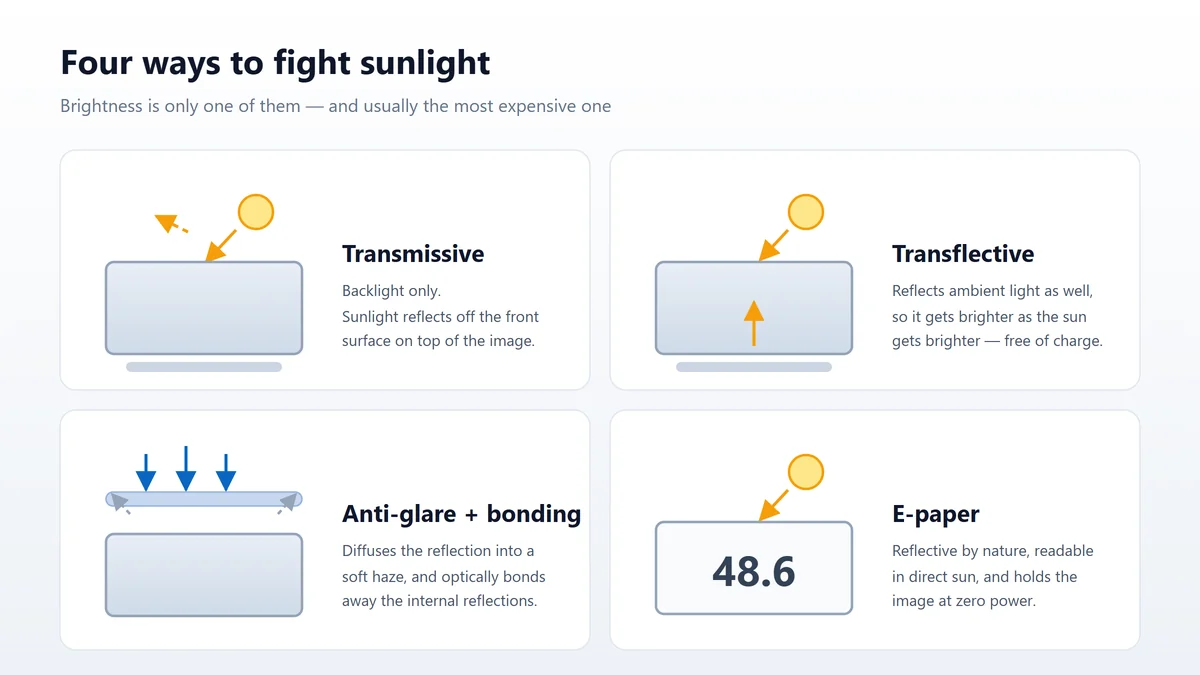
Lever one is brightness, and it is the one everybody reaches for first. A standard industrial panel runs 300 to 500 nits, which is fine indoors and not enough in sun. Outdoor products usually specify 800 to 1000 nits. Going beyond that helps, but each doubling costs power, generates heat, and shortens the backlight life — and if the reflection off the front surface is not addressed, extra brightness buys less than you expect.
Lever two is the polarizer. A transmissive panel relies entirely on its backlight. A transflective polarizer also reflects ambient light back through the liquid crystal, so the display gets brighter as the sun gets brighter, with no extra power. In direct sun a good transflective display is often more readable than a 1000-nit transmissive one. The trade-off is colour saturation and indoor appearance: transflective looks grey and low-contrast in an office, and still needs a backlight at night.
Lever three is the front surface. A glossy panel shows a mirror image of the sky, the user and the surroundings. Anti-glare treatment diffuses that reflection into a soft haze — the image softens slightly, but the hot spot disappears. Anti-reflective coating cuts the reflection without diffusing, but shows fingerprints and costs more. Optical bonding of a cover glass with index-matched adhesive removes the internal reflections between glass layers, which is often the single largest improvement per euro on a touch product.
Lever four is the display technology itself. Normally black panels look deeper in bright ambient light than normally white ones. FSTN and VA variants hold contrast better than TN when the light is strong. And if the product only needs to show a number that changes a few times a day, e-paper is worth a serious look: it is reflective by nature, readable in direct sun, and holds an image with no power at all. Our e-paper range covers 0.9 to 3.52 inches.
Heat is the hidden cost of brightness. A backlight running at twice the power puts roughly twice the heat into a module that may already be sitting in an enclosure at 60 °C ambient. Wide-temperature panels rated to +85 °C exist for exactly this reason, but the thermal design of the enclosure has to cooperate. Ask for the panel temperature, not just the ambient temperature, when you validate.
How to specify it properly. Tell us the ambient light level in lux, the viewing distance, whether direct sun actually falls on the glass or the panel sits in shade, how many hours a day it runs, what the power budget is, and whether it must be readable at night. Those six answers separate a 500-nit transmissive panel with an anti-glare film from a transflective panel with optical bonding — two very different products at very different costs.
What we do about it. We will not quote an outdoor display from a datasheet alone. Samples go outside, in real sunlight, and we compare them side by side at the same angle before recommending a construction. Bring us the enclosure drawing and the lux figure, and we will tell you which of the four levers is worth pulling for your product — and which one is a waste of money.